
Last Updated: November 5, 2026
Quick Summary
A patient centered approach to mental health is care built around the person rather than the diagnosis, treating your values, preferences, history, and goals as central to every decision. You are the expert on your own life, and your clinician brings medical knowledge, so decisions work best when both are combined.
- Patient-centered care focuses on the clinical encounter, while person-centered care looks at the whole person including life outside the clinic.
- Use the three-talk model in visits: team talk, option talk, and decision talk.
- Close each visit with a teach-back and set a specific review date.
- Individualized care plans should be living documents, reviewed often and changed when life changes.
- Pair experience questions with goal attainment and access data so results reflect outcomes, not just manners.
Table of Contents
- What the Patient Centered Approach to Mental Health Actually Means
- Patient-Centered Care vs Person-Centered Care: What’s the Difference
- Shared Decision-Making in Mental Health: Scripts and Tools That Work
- Patient-Centered Care Examples You Can Use in Practice
- Building Individualized Treatment Plans Around Lived Experience
- Adapting Care for Culture, Language, Disability, and Neurodiversity
- Measuring Patient Experience and Quality Improvement Indicators
- Preparing for Your First Patient-Centered Visit
- Frequently Asked Questions
What the Patient Centered Approach to Mental Health Actually Means
A patient centered approach to mental health is care built around the person rather than the diagnosis. It treats your values, preferences, history, and goals as central to every decision, not as background details.
The core idea is simple. You are the expert on your own life. Your clinician brings medical knowledge. Decisions work best when both are combined.
This differs from the older model, where the clinician decides and the patient follows instructions.
The Substance Abuse and Mental Health Services Administration describes person-centered planning as a process that honors the individual’s own goals and strengths. That principle now shapes much of behavioral health care.
The Core Principles Behind Patient-Centered Care
The principles are straightforward, but they take practice to apply well:
- Respect for preferences: Your beliefs, culture, and values shape what care fits.
- Shared power: Decisions are made together, not handed down.
- Lived experience counts: Your personal history is clinical information.
- Strengths over deficits: Care builds on what you already do well.
- Access and coordination: Care should be timely and joined up across providers.
These principles guide mental health services that put the person first. They also support recovery-oriented care, which focuses on a meaningful life rather than symptom removal alone.
Patient-Centered Care vs Person-Centered Care: What’s the Difference
The two terms are often used interchangeably. There is a subtle difference worth knowing.
Patient-centered care focuses on the clinical encounter. It asks how the clinician and patient work together during treatment.
Person-centered care is broader. It looks at the whole person, including life outside the clinic.
In practice, most mental health care blends both. The distinction matters most in how services get designed. A person-centered system asks what support someone needs to live well. A patient-centered visit asks how the two of you decide on treatment today.
Many organizations now use the terms side by side. The World Health Organization’s framework on integrated people-centered health services treats person-centeredness as a system-wide goal, not just a bedside manner.
Shared Decision-Making in Mental Health: Scripts and Tools That Work
Shared decision-making in mental health means clinician and patient weigh options together and agree on a plan. It works best with structure.
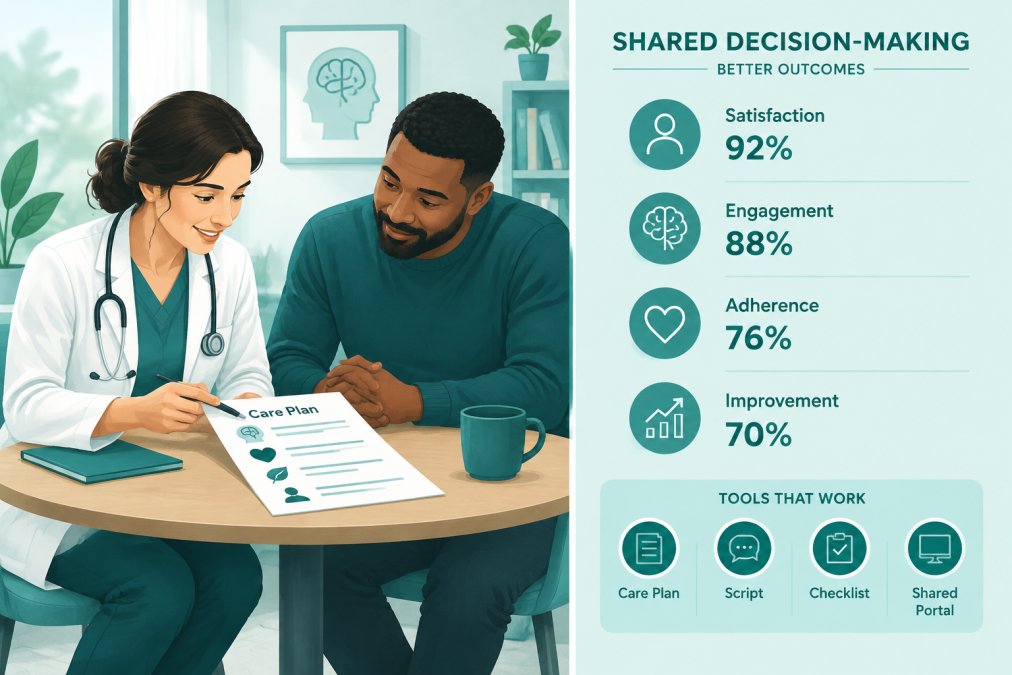
Step 1: Set the frame at intake. Before discussing any treatment, name the partnership. Ask what the person hopes will be different in their life and what they fear about treatment. Record both in the chart.
Step 2: Use the three-talk model in the visit.
- Team talk: “Let’s decide together what to do next.”
- Option talk: Lay out the realistic choices and their trade-offs.
- Decision talk: Agree on a plan and set a review date.
Step 4: Confirm the plan and the review date. Close with a teach-back: ask the person to say the plan in their own words.
Scripts you can borrow:
“Here are two options. Both are reasonable. Which fits your life better right now?”
“What matters most to you in the next three months?”
“What would make you feel this plan isn’t working?”
“Some people prefer to make the final call themselves, some prefer I recommend, and some want to decide together. Which do you prefer today?”
Tools that support the conversation:
- Preference checklist: communication style, decision role, language, accessibility, family involvement.
- Option comparison sheet: benefits, risks, requirements, and what happens if you wait.
- Goal card: the person’s own words for what a good week looks like, kept in the chart.
- Teach-back prompt: “Tell me how you’d explain this plan to someone at home.”
Step 5: Follow up and adjust. At the review, ask three questions: Did the plan fit your life? What got in the way? What should change?
Watch out: shared decision-making fails when it becomes a performance. If the clinician has already decided, patients sense it. Offer real choices or none at all.
Shared decision-making works best with a structured workflow from intake through follow-up.
For Appointments Call: 253-509-0424 →
| Step | What to do |
|---|---|
| Step 1: Set the frame at intake | Name the partnership; record hopes and fears; use a preference checklist |
| Step 2: Use the three-talk model | Team talk, option talk, decision talk |
| Step 3: Put options on paper | Use a one-page decision aid listing benefits, risks, requirements, and waiting |
| Step 4: Confirm the plan | Close with teach-back; set a specific review date |
| Step 5: Follow up and adjust | Ask: Did the plan fit your life? What got in the way? What should change? |
Patient-Centered Care Examples You Can Use in Practice
Concrete patient-centered care examples make the approach easier to picture. These come up often in mental health settings.
- Choice of treatment format: Offering therapy, medication, or a combined plan, then explaining the trade-offs.
- Flexible scheduling: Matching appointment times to work and caregiving demands.
- Goal-setting led by the patient: Asking what a good week looks like before writing a care plan.
- Family involvement on the patient’s terms: Inviting support people only when the person wants them.
- Plain-language education: Explaining a diagnosis in everyday words and checking understanding.
Addiction care shows this well. A person-centered plan asks what recovery means to that individual, not just whether they stopped using. Readers who want to explore this further can read our article on recognizing when addiction is ruining your life.
Building Individualized Treatment Plans Around Lived Experience
An individualized care plan starts with the person’s story. Two people with the same diagnosis may need very different plans.
Individualized plans are typically built around:
- What has helped before, and what has not
- Current stressors like work, housing, or family
- The person’s own goals, not just symptom targets
- Cultural and spiritual beliefs that shape care
A common mistake is treating the care plan as a form to complete. It should be a living document. Review it often and change it when life changes.
Some patients also ask about complementary options. For readers curious about adaptogens, our article on ashwagandha and mental health covers what the evidence does and does not support. We present these as options to discuss with a clinician, never as replacements for standard care.
Adapting Care for Culture, Language, Disability, and Neurodiversity
Good care adapts to the person in front of you. That means adjusting for culture, language, disability, and neurodiversity.
Practical steps include:
- Using qualified interpreters rather than family members
- Offering written materials in the person’s preferred language
- Asking about sensory needs and accessibility upfront
- Recognizing that neurodivergent patients may communicate differently
- Avoiding assumptions based on background or diagnosis
For neurodiverse patients, a rigid appointment structure can be a barrier. Small changes help. Shorter sessions, written agendas, and clear next steps all reduce friction.
The CDC’s overview of ADHD notes that ADHD affects people across the lifespan, not just children. Care should reflect that. Our own guide on understanding ADHD explains how symptoms show up in adults.
Measuring Patient Experience and Quality Improvement Indicators
You cannot improve what you do not measure. Patient experience data shows whether care is truly person-centered. This section gives a practical measurement and quality-improvement approach that most principle-level guides leave out.
What to measure. Track a small set of indicators across four domains:
- Experience: whether patients felt listened to, how involved they felt in decisions, and whether they understood their plan.
- Goal attainment: progress on the person’s own goals, not only symptom scores.
- Engagement and access: timely access to appointments, no-show and cancellation patterns, and continuity between visits.
- Coordination: whether providers shared information and whether the person had to repeat their story.
How to collect it. Short post-visit surveys work well, and open questions add context: “What would have made this visit better?” Use a consistent tool so results can be compared over time. The Agency for Healthcare Research and Quality publishes survey tools for measuring patient experience in behavioral health, and the Substance Abuse and Mental Health Services Administration offers person-centered planning resources that can inform what you ask about goals and preferences.
A simple quality-improvement loop.
- Pick one indicator, such as “patients felt involved in decisions.”
- Collect a baseline for a month.
- Make one change, such as adding a preference checklist at intake or a decision aid in visits.
- Re-measure after a month and compare.
- Keep what worked and repeat with the next indicator.
Make feedback actionable. Feedback loops only help if you act on what you hear. Review comments in team meetings, assign an owner for each change, and tell patients what changed as a result. That closes the loop and builds trust.
Watch out: measuring only satisfaction scores can reward a pleasant visit over a useful one. Pair experience questions with goal attainment and access data so the picture reflects outcomes, not just manners.
Preparing for Your First Patient-Centered Visit
A first visit sets the tone. A little preparation helps you get the most from it.
Bring a short list:
- What brought you in, in your own words
- Treatments you have tried and how they went
- What matters most to you right now
- Questions you want answered
Expect the clinician to ask about your life, not just your symptoms. That is the point. You should leave with a plan you helped shape, and a clear sense of next steps.
If you have felt rushed or dismissed by past providers, say so. A good clinician will want to know.
You can learn more about our personalized primary care and how we approach whole-person wellness on our primary care page.
Frequently Asked Questions
What is patient-centered care in mental health?
Patient-centered care in mental health means treatment is organized around the person receiving it, not around the clinician’s preferred protocol. You bring your values, goals, personal history, and lived experience into the conversation, and the care plan reflects them. In practice this shows up as shared decision-making, individualized treatment planning, clear patient education, and a therapeutic relationship built on respect. The aim is care that fits your life and supports recovery-oriented goals rather than simply suppressing symptoms.
How does person-centered care differ from patient-centered care?
The two terms overlap heavily and are often used interchangeably. Patient-centered care grew out of medical settings and emphasizes respect for patient preferences, autonomy, and informed decisions within a clinical encounter. Person-centered care, more common in behavioral health and social services, focuses on the whole person, including strengths, goals, community, and lived experience beyond the diagnosis. Many organizations now use person-centered care as the broader term. What matters most is that your care team applies the principles consistently, whatever label they use.
What are examples of patient-centered care in a mental health setting?
Practical examples include offering a written or digital care plan you help draft, using teach-back to confirm you understand medication options, scheduling around your work or caregiving obligations, and inviting a family member or peer supporter into sessions if you want one there. Shared decision-making tools such as decision aids for antidepressant choices are another. So is asking directly about culture, language, disability, and neurodiversity needs at intake rather than waiting for you to raise them. Each example shifts control toward the person receiving care.
How can I take an active role in my mental health treatment?
Come to appointments with two or three specific goals and a short list of questions. Ask what the evidence says about each option, including the option of waiting or trying a non-medication approach first. Request your care plan in writing and ask for the parts you disagree with to be noted. If a clinician dismisses your concerns, say so plainly and ask what would change their recommendation. Patient engagement improves when you treat the visit as a working meeting rather than a verdict being handed down.
Feeling heard should not be a rare experience in health care. At The Dynamic Care Clinic, we build care around your history, goals, and preferences, pairing personalized primary care with advanced regenerative treatments and bio-identical hormone support. Our team helps you make informed decisions with confidence, not pressure. Call 253-509-0424 to schedule a visit and start a care plan built around you.

Recent Comments