
Last Updated: November 4, 2026
Quick Summary
Gentle stretching supports tendonitis recovery when it stays within a comfortable range and avoids sharp or lingering pain. Hold calf, Achilles and hamstring stretches for 20 to 30 seconds, two to three times per side, and warm up with two to three minutes of easy walking first. If pain worsens or does not improve after several weeks, see a qualified clinician.
- Warm the tissue for two to three minutes with easy walking or ankle circles before stretching.
- Hold each calf, hamstring and quad stretch for 20 to 30 seconds, two to three times per side.
- Use a mild pulling sensation as the target; sharp or burning pain means you have gone too far.
- Check pain the next morning, since tendon irritation often shows up hours later.
- Keep stretches static, avoiding bouncing or ballistic movement early in recovery.
Table of Contents
- Understanding Tendonitis and Why Gentle Movement Matters
- Tendonitis Recovery Timeline: What to Expect Week by Week
- Gentle Stretches for Calf, Achilles and Hamstring Tendons
- Telling Good Discomfort From Bad Pain
- Equipment-Free Modifications and Recovery Routines
- Nutritional Support for Connective Tissue Repair
- Regenerative Medicine for Chronic Tendonitis: Where It Fits
- Booking Your Tendonitis Assessment at The Dynamic Care Clinic
- Frequently Asked Questions
Tendonitis is inflammation of a tendon, the tough cord that joins muscle to bone (the NHS). It often flares in the calf, the Achilles, the hamstrings and the patellar tendon below the kneecap. The right kind of gentle stretching can support tendonitis recovery, but the wrong kind can set you back. This guide is designed to help you move safely while your tendon heals. (Source: data on the prevalence of musculoskeletal conditions)
Understanding Tendonitis and Why Gentle Movement Matters
Tendonitis is the irritation and swelling of a tendon, usually from repeated stress or sudden overload. Tendinosis is the longer-term version, where the tendon fibers break down slowly without much visible inflammation. Both respond better to controlled movement than to complete rest.
Rest helps early on, but a tendon that stays still for too long can stiffen. Gentle movement encourages blood flow and helps the tendon tolerate load again.
- Calm, pain-limited movement keeps the tendon from stiffening
- Gentle load signals the tissue to remodel and get stronger
- Complete rest often leads to weaker, more reactive tendons
Tendonitis Recovery Timeline: What to Expect Week by Week
Recovery rarely moves in a straight line. Most people notice pain easing gradually, with setbacks after hard days. Your timeline depends on how long the problem has been present, your activity level and how well you manage load.
In the first one to two weeks, focus on reducing pain and keeping gentle range of motion. In weeks three to six, you can usually add light strengthening and longer holds. After that, many people slowly return to their normal activity, with careful load management.
If your pain is getting worse, or does not improve after several weeks, speak with a qualified clinician before continuing.
Gentle Stretches for Calf, Achilles and Hamstring Tendons
Gentle stretching works best when you stay within a comfortable range, hold steadily, and breathe normally. The goal is to restore tolerance to length, not to force a new range. Many practitioners suggest that two to three short sessions per day may be easier on a tendon than one long session.
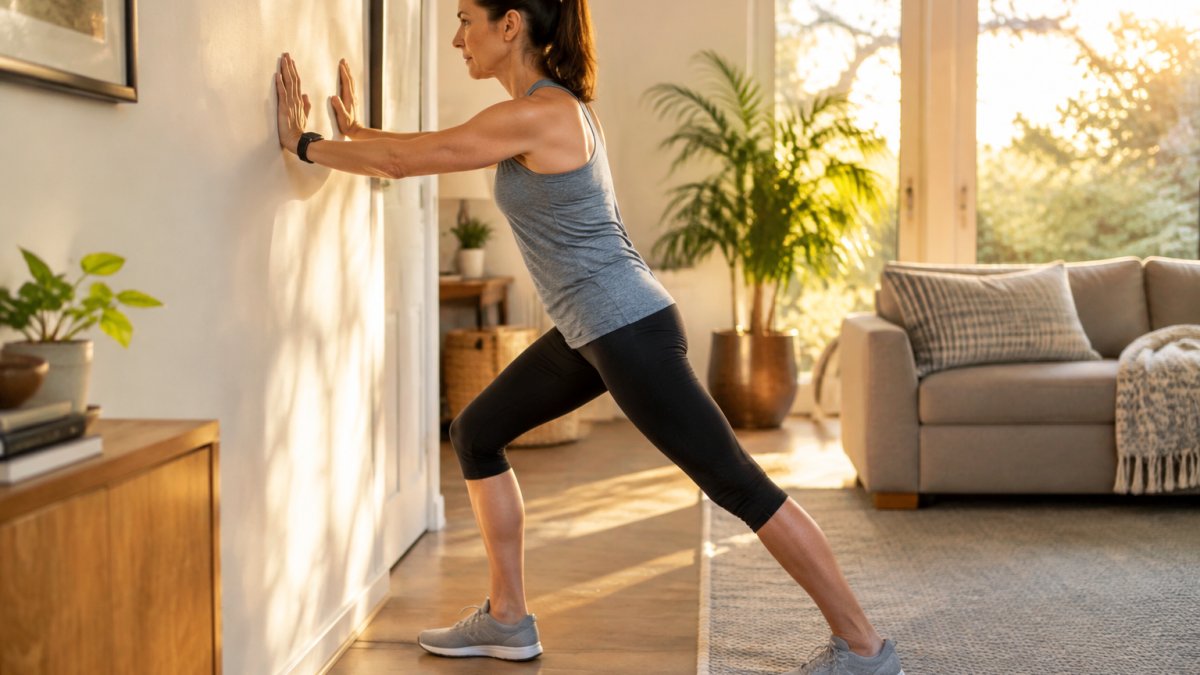
A useful rule before you start: warm the tissue for two to three minutes with easy walking or ankle circles. Cold tendons are less forgiving, and stretching a cold, irritated tendon is one of the most common reasons a routine backfires.
Calf and Achilles Stretches
The calf and Achilles tendon often tighten after a flare. These stretches need no equipment, and you can do them at a wall or countertop.
Standing wall calf stretch (gastrocnemius)
- Stand facing a wall with your hands at shoulder height.
- Step one foot back and keep the back heel on the floor, back knee straight.
- Bend the front knee gently until you feel a mild stretch in the upper calf.
- Hold for 20 to 30 seconds, then switch sides. Repeat two to three times per leg.
Bent-knee calf stretch (soleus and lower Achilles)
The soleus sits beneath the gastrocnemius and attaches lower on the Achilles, so it needs a bent-knee position to load.
For Appointments Call: 253-509-0424 →
- Take the same wall position, but bend the back knee slightly while keeping the heel down.
- You should feel the pull lower in the calf, closer to the ankle.
- Hold 20 to 30 seconds, two to three times per leg.
Seated towel calf stretch
Watch out: pressing the heel down hard or bouncing at the end range is the most common way people irritate the Achilles.
Hamstring and Patellar Stretches
The hamstrings support the knee and hip, and when they are tight they can tug on the patellar tendon with every step.
Seated single-leg hamstring stretch
- Sit on the floor with one leg straight and the other bent to the side.
- Lean forward slowly from the hips, keeping your back long rather than rounding.
- Hold for 20 to 30 seconds and breathe slowly.
- Repeat two or three times per side.
Standing hamstring stretch with a chair
Place one heel on a low chair or step with the knee slightly bent, keep the back flat, and hinge forward from the hips until you feel a mild pull behind the thigh.
Quad and patellar tendon stretch
The patellar tendon connects the kneecap to the shin bone, and the quadriceps above it can pull it tight.
Watch out: pulling the heel all the way to the glutes can compress the knee joint and aggravate the patellar tendon.
How to Progress Without Flaring
Start with one round of each stretch per session for the first week. If pain stays at or below your baseline the next morning, add a second round.
Keep the holds static. Bouncing or ballistic stretching loads the tendon with rapid changes in length, which is the opposite of what an irritated tendon needs early in recovery. Save dynamic work for after the tendon has settled and you have added strengthening.
The table below summarises the key stretches and the holds and frequencies the article recommends.
| Stretch | Hold or frequency | Key cue |
|---|---|---|
| Standing wall calf stretch | 20-30 seconds, 2-3 times per leg | Heel stays down, back knee straight |
| Bent-knee calf stretch | 20-30 seconds, 2-3 times per leg | Bend back knee slightly, pull felt lower in calf |
| Seated towel calf stretch | 20-30 seconds | Mild pull, not burning or sharp |
| Seated single-leg hamstring stretch | 20-30 seconds, 2-3 times per side | Keep back long, do not round |
| Standing hamstring stretch with chair | 20-30 seconds per side | Heel on low chair, back flat |
| Quad and patellar tendon stretch | 20-30 seconds per side | Stop before knee pressure |
Telling Good Discomfort From Bad Pain
Some discomfort during gentle stretching is normal. The key is knowing which kind you are feeling.
- Good discomfort: a mild pulling feeling that eases within a minute after you stop
- Bad pain: sharp, stabbing or burning pain, or pain that lingers for hours
If pain spikes during a stretch, stop and back off. If pain is worse the next morning, reduce the intensity of your routine.
For Appointments Call: 253-509-0424 →
Equipment-Free Modifications and Recovery Routines
You do not need special gear to stretch safely. A wall, a chair, a towel, and a couple of books are enough for most routines. This section covers the bodyweight-only substitutions, then the post-stretch recovery steps that most guides skip.
Bodyweight-only substitutions
- Towel for a strap: loop a towel around the ball of the foot for hamstring and calf stretches when you cannot reach your toes.
- Chair for balance: use a sturdy chair or countertop for standing calf and quad stretches instead of a wall if you have shoulder pain.
- Step or book for heel elevation: a thick book or the bottom stair replaces a slant board for a low-load calf stretch.
- Doorframe for chest and hip flexor work: place a forearm on the frame and step through to open the front of the hip, which often tightens alongside hamstring and patellar problems.
- Wall sit for isometric loading: hold a shallow wall sit for 20 to 30 seconds to load the quad and patellar tendon without movement. Isometrics are a common bridge between stretching and full strengthening.
Post-stretch recovery protocol
What you do in the ten minutes after a stretch matters as much as the stretch itself. A practical sequence some people find helpful:
- Cool down with easy movement. Walk for two to three minutes to restore circulation rather than sitting immediately.
- Ice only if there is new swelling or a flare. Apply a cold pack for 10 to 15 minutes, never directly on skin. Ice is for calming an irritated tendon, not for routine use after every session.
- Use heat before activity, not after. A warm pack for 10 minutes before stretching can loosen a stiff tendon; heat after a flare can increase swelling.
- Try gentle self-massage. Use a thumb or a tennis ball to roll the calf or thigh for one to two minutes, staying off the tendon itself. Work the muscle, not the sore spot on the tendon.
- Elevate if the area is puffy. Prop the leg on a pillow for 10 minutes to help swelling settle.
Watch out: aggressive foam rolling directly over an inflamed tendon can increase irritation. Keep pressure on the muscle belly and skip the tendon itself until pain has settled.
Pacing for the long haul
Tendon recovery often takes weeks to months, and the mental fatigue of a slow timeline is real. A simple pacing rule helps: plan two lighter days after any day you add a new stretch or increase holds. Track pain on a 0 to 10 scale each morning and keep a written log for two weeks; patterns are easier to see on paper than in memory.
Nutritional Support for Connective Tissue Repair
Connective tissue relies on steady nutrition to repair. A balanced diet with enough protein, vitamin C and overall calories is commonly discussed as part of general health. Hydration also matters, since tendons are largely water-based tissue.
Nutrition is one part of a recovery plan and does not replace a proper exercise plan or medical care. Talk with a qualified professional before starting any supplement.
Regenerative Medicine for Chronic Tendonitis: Where It Fits
For tendon problems that persist despite careful stretching and load management, some people explore regenerative medicine. Some people explore these approaches, and their use varies with each person’s situation. Outcomes are not guaranteed, and a qualified clinician can explain what may or may not suit your case.
Learning about your options can help you prepare questions for a clinician. Our guide to regenerative medicine for sports injuries covers how these treatments apply to athletic tendon problems. You can also compare regenerative care clinics to understand what different providers offer before you decide where to go.
Booking Your Tendonitis Assessment at The Dynamic Care Clinic
If your tendon pain is not improving, a professional assessment can clarify what is going on and what options make sense for you. The Dynamic Care Clinic’s clinician team evaluates each patient individually, and you can explore the clinic’s primary care and regenerative treatment offering to see how to get started.
To schedule an appointment, call 253-509-0424. Our team at The Dynamic Care Clinic is here to help you move forward with a plan that fits your health history and goals.
Frequently Asked Questions
When should you start stretching for tendonitis?
Gentle stretching is usually introduced once acute pain has eased enough that movement no longer causes sharp or escalating discomfort. Many people begin with pain-free range-of-motion work and add light stretches as tolerance improves. Because timing depends on your injury, history and symptoms, confirm the right starting point with a qualified clinician before beginning a new routine, especially if swelling or night pain is present.
Can stretching make tendonitis worse?
It can, if stretches are too aggressive or performed through sharp pain. A useful rule is that mild discomfort which settles within a few minutes after stopping is generally tolerable, while pain that lingers, sharpens or worsens the next day suggests the load was too high. Reduce the intensity, shorten the hold, and seek professional guidance if symptoms persist or escalate.
What are the best gentle stretches for Achilles tendonitis?
Commonly discussed options include a straight-knee and bent-knee calf stretch against a wall, and slow heel-drop movements performed within a comfortable range. Holds are typically kept gentle, often around 20 to 30 seconds, with few repetitions. Eccentric loading is sometimes added later under clinical supervision. Individual suitability varies, so review any exercise plan with a qualified professional.
How does functional medicine support tendon healing?
Functional medicine looks at contributing factors such as nutrition, sleep, stress, load management and inflammation alongside the local tendon problem. The goal is a personalized plan that supports the body’s own repair processes rather than only masking pain. Outcomes vary between individuals, and a consultation with a qualified provider can help determine which elements are relevant to your situation.

Recent Comments